
You do not need a brilliant original idea to build a real income online.

You just need to borrow one that already works.
That sentence sounds almost too simple to be true, yet it built some of the biggest brands on the planet. Long before Richard Branson owned airlines and record labels, he signed a licensing deal for one song. Before George Lucas became a household name, a licensing deal saved his second Star Wars film from never being made at all.
Here is the licensing income model almost nobody explains to beginners in plain terms. It is not a get-rich-quick trick, and it is not reserved for Hollywood studios. It is a decision to sell something proven instead of waiting to invent something new.
If you have spent months circling your own blank page, this is the shift that changes everything. You keep wondering what you could create that people would pay for. But the product does not have to come from your imagination. It only has to come from a license you are allowed to sell.
The Same Model Behind Star Wars And Virgin
You already know Star Wars. You already know Virgin. What you may not know is that both empires were built on a licensing deal, not a mountain of raw creativity poured out from scratch.
In the 1970s, a young Richard Branson signed a deal to license one record: Tubular Bells by Mike Oldfield. That single agreement spent 247 weeks on the charts. It funded Branson’s first Virgin store on Oxford Street. Airlines, mobile networks, and record labels followed years later.
George Lucas faced a harder problem. His first Star Wars film succeeded, yet he had no budget left to make The Empire Strikes Back. So he asked the studio for something unusual: the license to turn his own characters into toy figurines. The studio laughed. Lucas pressed ahead anyway.
That one licensing deal for toy figurines bankrolled an entire film franchise. It now spans toys, clothing, video games, and theme parks.
That one licensing deal for toy figurines bankrolled an entire film franchise that now spans toys, clothing, video games, and theme parks.
Two graphic artists once drew four turtles for a comic book. Within three years, licensing deals for Teenage Mutant Ninja Turtles merchandise had generated over $400 million in wholesale sales. The two artists kept ten percent of it. They never manufactured a single toy themselves.
None of these people invented a new business model. They understood one thing you can put to work starting this week. A proven product, sold under the right license, can outperform a brand new idea every time. That single truth applies just as much to a solo beginner working from a laptop as it did to a filmmaker or a record label.
Why This Licensing Income Model Works For Beginners Too
Big studios are not the only ones who benefit from this licensing income model. Ordinary beginners use the exact same principle. They just work on a smaller scale, with a smaller license fee and a much faster path to their first sale.
Take Rupen Doshi. He was not a movie studio or a record label. He was a student who wanted to sell something online without spending months creating it from a blank page. Once his licensed product went live, he made $5,815 in the first five days.
Results like his are exceptional and not typical. His outcome depended on the market he chose, the offer itself, and the work he put into promoting it. I share his story to make one specific point. The wait between deciding to sell something and selling it can be measured in days, not months, when you license instead of create.
You can read more warning signs to check before you license anything in other posts I have shared recently. Learning to spot those red flags first protects the income this model can produce.
What Changes When You License Instead Of Create
Creating an original product asks you to be the writer, the designer, and the expert. It asks all of that before you make a single sale. Licensing asks something different of you.
It asks you to be the seller.
Somebody else already wrote the content, tested it on a real audience, and worked out what problem it solves. Your job shifts from inventing a solution to placing a proven one in front of the right buyer.
This is not a smaller version of building a business. It is the same licensing income model Branson and Lucas used. It is only scaled down to a size you can manage from your own home, without a studio budget or a record label behind you.
The buyer on the other end of your sale does not know or care whether you wrote every word yourself. They care whether the product solves their problem. A well-chosen license solves it exactly as well as an original product would. It often solves it faster, because someone has already proven the demand exists.
The One Question Worth Asking Before Your Next License
Before you license your next product, ask yourself one question. Has this exact type of content already sold well somewhere else?
Branson did not guess that Tubular Bells would resonate. He watched a song build an audience first. Then he negotiated the rights to profit from it. Lucas did not invent toy figurines either. He licensed characters that audiences had already fallen in love with on screen.
The evidence always comes before the license, never after it.
Beginners who skip this step often end up with a license nobody wants. Beginners who check the evidence first end up with a license that sells itself. The market already proved it wanted exactly this.
The Real Cost Of Waiting For A Better Idea
Every week you spend waiting for the perfect original idea is a week someone else spends selling a license they found last month. Waiting feels safe. It rarely is.
The wait has nothing to do with a lack of options. Thousands of licensed products already exist across dozens of markets. Formats range from short reports to full home study courses. The wait comes from a quieter fear. It is the worry that licensing somehow counts less than creating something from nothing.
It does not count less. Branson did not write Tubular Bells. Lucas did not carve his own action figures out of plastic. Both men built lasting income by recognizing value that already existed. Then they moved fast to capture it, before anyone else did.
Your first sale is not waiting on a flash of inspiration. It is waiting on you choosing one proven license and starting.
Most beginners overestimate how much has to be original and underestimate how much only has to be present. A license already covers the hardest part for you: the research, the writing, and the testing. What it cannot do is choose itself. That part is still yours. It takes far less time than most beginners expect once they stop searching for permission to begin.
A Model That Rewards Action, Not Talent
None of the people in these stories had some rare gift the rest of us are missing. Branson was a mail order seller before he became a music mogul. Lucas was a filmmaker working in low-budget studios that showed adult films after dark. Two graphic artists drew turtles for fun before turtles became a $400 million licensing business.
The difference between people who profit from this licensing income model and people who never start is rarely talent. It is action.
You already have access to more done-for-you licensed products than any of them did when they started. The barrier that used to stop beginners was the cost and difficulty of finding a legitimate license. That barrier is smaller today than it has ever been.
Every story here began the same way: with one small, unglamorous decision to license something instead of waiting to invent it. Nobody in these stories asked for permission first. They picked a proven asset, moved fast, and let the results speak for themselves afterward. That order, asset first, action second, permission never, is the whole licensing income model in one sentence.
The blank page that has stopped you does not have to stop you any longer.
If this idea feels exciting but you are not sure where to find a legitimate license, The Licensing Vault was built for exactly that gap. Instead of hunting across the internet for a license that might be outdated or shoddy, you get a package of done-for-you information product licenses. Each one comes complete with a sales letter, graphics, and web templates. Promotional emails and full private label rights are included too.
The Instant Set Up Wizard walks you through setting up each product step by step. Even if you have never done this before, you can have a product ready to sell in around thirty minutes. No content creation required. No guesswork about where to start.
You can explore The Licensing Vault to see the full details.
You do not need to be the next Lucas or Branson to use this model. You only need to place one proven product in front of the right buyer. Then let the licensing income model do what it has always done.
I am rooting for you, wherever you decide to start.
Nick James
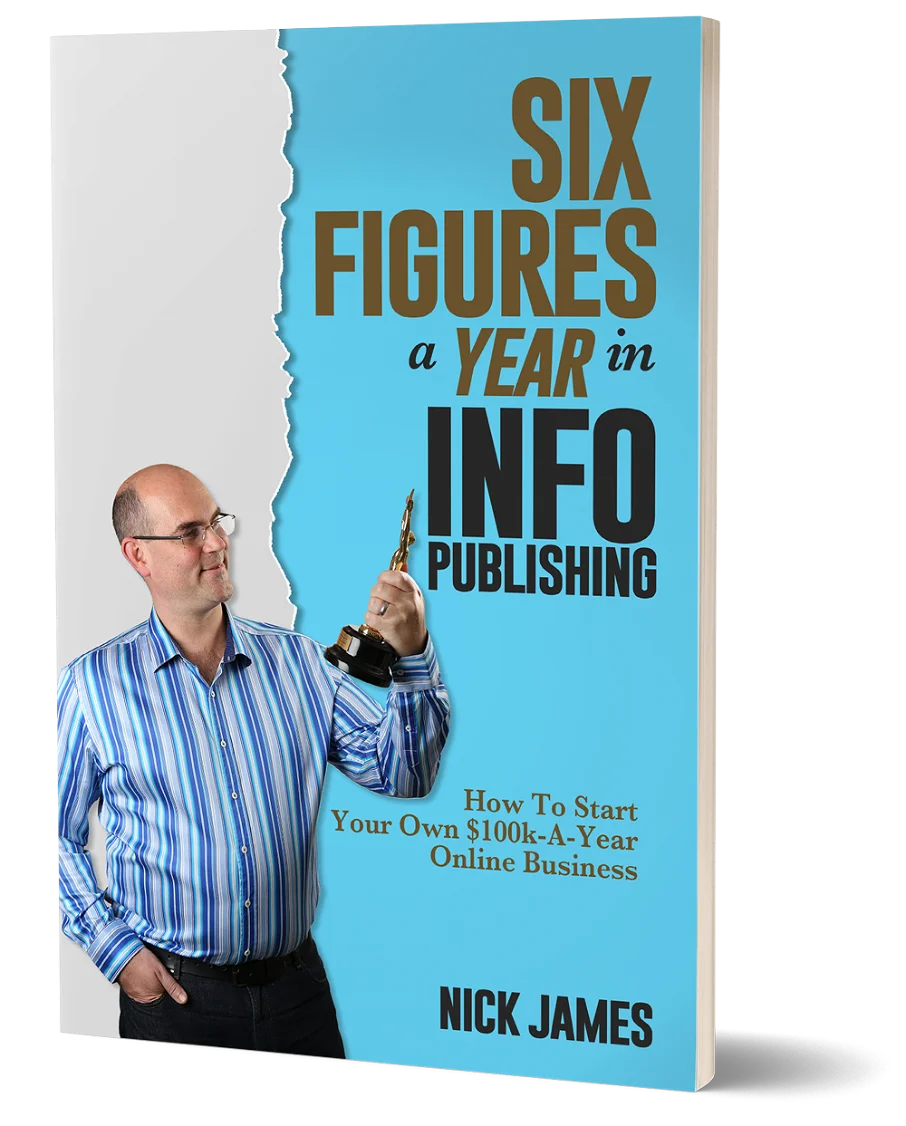
Author offers a FREE copy of this book to his next door neighbor... to prove he's not a drug dealer!
Now claim your FREE COPY.
and follow the step-by-step instructions for making the kind of money (and living the kind of lifestyle) that'll get your neighbors curtains twitching with curiosity!
Enter your details below to discover how to claim your FREE COPY of 'Six Figures A Year In Info Publishing' ...
Privacy Policy : We value your privacy. You can unsubscribe from receiving future emails with 1 click at any time.